About Us
Human-Centred Architecture, Supported by Science
We spend 90% of our time in buildings. Yet most of these spaces are designed without a deep understanding of their users.
How can we build for humans when we don’t understand how they function? How can we create suitable spaces if we ignore how our brains perceive, feel, and interact with the environment?
This is where we come in.
Who Are We?
Our agency, based in Toulon, southern France, is led by Dr. Marina Russo Schtcherbakoff Kodakoff, one of the few professionals worldwide to hold a PhD in neurosciences applied to architecture, with over 16 years of experience in research and practice. Initially trained in Architecture, she later specialised in Neuroscience and Clinical Psychology, bringing a rare dual expertise to every project. This ensures that spaces are not just aesthetically pleasing but effective on cognitive and behavioural levels.
Several of our research studies have been published and presented at international conferences.
Unlike other architecture or decoration professionals, we do not rely on trends or subjective preferences. Instead, we apply rigorous neuroscientific methods to:
- Decipher how people truly experience spaces (beyond what they can express).
- Anticipate the invisible impacts of design choices on health, cognition, and social dynamics.
- Transform complex data into concrete, human-centred solutions.
Our work is built on three core principles:
- Science over assumptions – Every recommendation is backed by research in neuroscience, environmental psychology, and behavioural studies.
- Precision over intuition – We measure, analyse, and validate the effects of light, colour, and spatial layout on users.
- Impact before aesthetics – Beauty matters, but well-being and functionality must never be compromised. We reconcile both, making spaces more “beautiful” through users’ perception.
A Pioneering Approach
Neuroarchitecture bridges the gap between scientific research and architectural practice. While intuition and aesthetics have long guided design, scientific data allows us to go further: creating environments that respond to real human needs, not assumptions.
Experts in Colour and Light
Most discussions on “colour psychology” rely on oversimplified generalisations (“blue is calming,” “red is stimulating”). We reject these reductive claims. Colour perception is deeply influenced by cognitive biases, socio-cultural factors, and habituation. While colours can have universal physiological effects, their psychological and cognitive impacts vary depending on perception. Associating a single colour with a fixed impact is a mistake.
Our expertise lies in decoding these individual and collective responses to recommend colours and/or design spaces that are truly aligned with users’ physiological and psychological needs.
The same applies to light, a crucial yet often mismanaged element. We don’t just consider technical parameters like lux, lumens, Kelvin, UGR, or CRI—we analyse how intensity, spectrum, and light distribution interact with human biology and behaviour. Poor lighting disrupts sleep, concentration, mood, and can even create a sense of insecurity. We optimise it scientifically to better align with the desired visual and human objectives.
Why Does This Matter?
Because a space that ignores human neuroscience is a space that fails its users—whether it’s a home that doesn’t feel like a sanctuary, an office that drains its occupants, or a public space that feels unwelcoming.
We don’t just design places. We design experiences—shaped by real human needs, not subjective ideas.

Pioneering rigorous, human-centred and evidence-based approaches to architecture and spatial design – often referred to as ‘neuroarchitecture’.

Hundreds of participants and end-users involved.
Across research studies, professional projects and field observations.

Led by a scientific research professional holding a PhD in architecture and neuroscience.
What We Offer
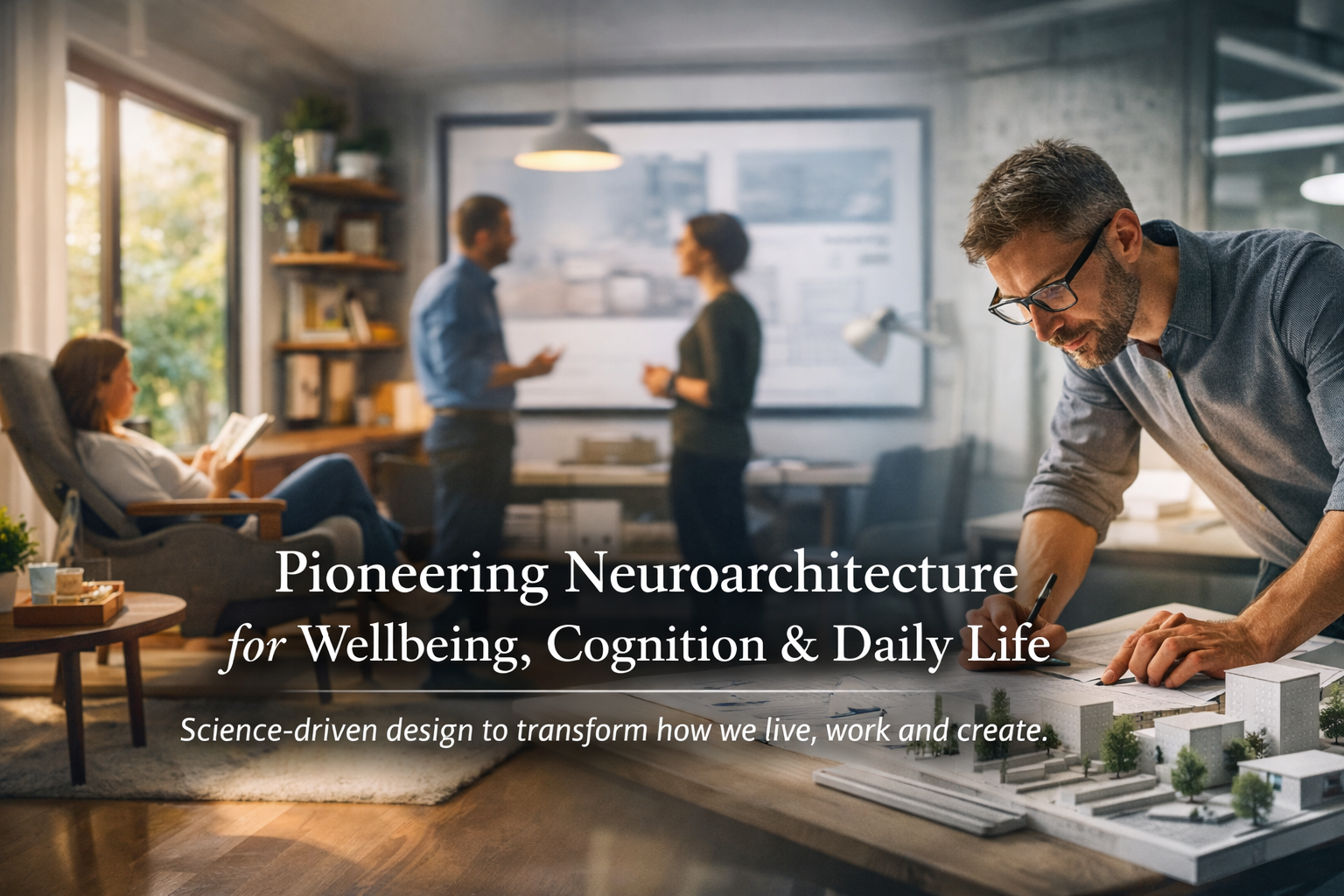
For over 16 years, we have been pioneering neuroarchitecture, combining rigorous science with a human-centred approach to create spaces that genuinely support wellbeing, cognition and daily life
Whether you are an individual seeking a home that truly works for you, a business or public institution aiming to optimise performance and engagement, or a professional of the built environment looking to innovate, we provide insight, research and guidance grounded in evidence and real-world experience.
Discover how our consultancy, research, training and lectures can help you rethink spaces, enhance experiences and make design decisions that truly matter.
Expert Advice, Research & Training to Empower Your Projects